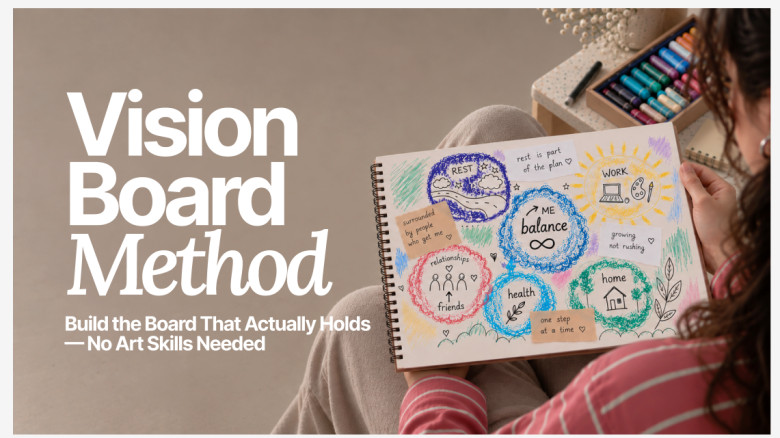
Vision Board Method: Build the Board That Actually Holds — A 9-Lesson Paper Practice at Home
Every January, the same advice: picture what you want, put it on a board, look at it every day. So you did. A beach, a kitchen, someone else's life in magazine cut-outs. By March it was behind the wardrobe door. Here's what nobody tells you — a picture of a future you can't yet describe doesn't move you anywhere. Researchers who study goal-setting found the opposite: the more pleasantly people daydream a future, the less they do about it. Vision Board Method starts one step earlier. You map what's real right now, on paper, in your own handwriting — and build the board out of that. Nine short lessons from a certified art therapist. Ten minutes at the kitchen table, no art skill needed.
We guarantee to refund the course purchase price, if the course did not meet your expectations. To request a refund, please email our Support Service at [email protected] within 14 calendar days from the purchase date.
Comments about the course
-

I have made a vision board every single January since 2019 and I could not tell you where one of them is 😅 This is the first time anyone had me draw where I actually am before jumping to the pretty part. Week one page is on my fridge. Week three board is in the hallway and I still look at it.
-
Honestly I only bought it because I'd said 'I don't know what I want' to my sister for about the fifth time and heard how it sounded 😩 Lesson 3 was uncomfortable. Two of my five circles were basically empty and had been for years. But that's the whole point isn't it. By week two I could actually answer the question.
-

I am not creative. Never have been, my sister got that gene. I fully expected to feel stupid 🙈 It's circles and words and torn-up bits of paper. My handwriting is awful and it does not matter at all. First page took me eleven minutes and I sat there quite pleased with myself.
-

I spent about $70 on supplies for a workshop two years ago that I never went back to — the bag is still in the cupboard, I used the exact same bag for this 😂 Nothing new to buy. Nine lessons, ten minutes, kitchen table, done while the kettle went on.
-

Youngest went to uni in September and the house got very quiet very fast. I wasn't sad exactly, just... nobody needed me at four o'clock anymore 💛 The map lesson showed me I'd built my whole week around people who'd left. Week 4 and I have a board that's about me. First time in about twenty years.
-
My husband walked past and asked what I was doing, then sat down and did one too 😄 We've got both maps up in the kitchen now. Week 2 mine was better than his, obviously. It's the writing-it-down bit that does something — I'd never got that from just looking at photos on Pinterest.
Course includes
You Didn't Lack Discipline. You Built the Board Before You Knew What You Wanted.
ARE THESE FAMILIAR?
- You've made a vision board before — and you couldn't say what became of it
- You know exactly what you don't want anymore; the wanting part is where you go blank
- Someone asks what you'd love this year and you hear yourself say "oh, I don't know really"
- The kids are grown, or nearly, and nobody needs you at four o'clock the way they used to
- Your days have narrowed down to two things, and the rest quietly went somewhere
- You've saved a hundred boards on Pinterest and made none of them
- "I'm not the creative one" is something you've said out loud, more than once
- Underneath it all, you worry that this is simply what the next twenty years look like
HERE'S WHAT NOBODY TELLS YOU
A vision board is a picture of a destination. You cannot draw a destination from a place you've never actually looked at.
And it's a trap that feeds itself. You can't name what you want, so you borrow someone else's picture. It doesn't fit, so you never act on it. Nothing changes, so you decide you're not the sort of person this works for — and you end the year less able to name what you want than when you started.
This is why every shortcut fails you. Pinterest, the printable templates, the January workshop — all of them start at the end. They hand you the destination and skip the part where you look at where you're standing.
You didn't lack discipline. You built the board before you knew what you wanted. And an order can be changed.
WHAT CHANGES WHEN YOU START WITH THE MAP
- You can finally name what you want — in plain words, not vague ones
- You see which parts of your life have quietly gone empty, at a glance
- You make something with your hands that still exists when the session ends
- You build a board you'll still want on the wall in September
- Ten minutes at the kitchen table, with whatever's already in the house
Your wanting isn't broken. It was simply never put on paper.
HOW VISION BOARD METHOD WORKS
1. Draw where you actually are. Five circles — work, rest, home, health, people. You fill the ones that are full and you see the ones that aren't. A circle and a word is enough.
2. Name what you need more of, and less of. One page split down the middle — where vague feelings turn into two short lists you can read back.
3. Clear the space. You write down what you're ready to stop carrying and take it off the page, physically, with your hands.
4. Build the board. Now the cutting and gluing. Every image answers something you mapped in the first three steps — which is why it holds.
5. Make your compass. One small page pulling it together — what matters, where you're heading, what you've got to get there.
Why choose this course?
Every vision board asks what you want. None of them ask what's actually changing — that's why they end up in a drawer.
- The order is the method. Present first, future second — the whole difference between a board that holds and a pretty page you stop seeing.
- Nothing to buy. A notebook, a pen, whatever colour is in the house. No printer, no Canva subscription, no $60 supply run.
- Built for women who don't draw. Circles, words, torn paper, cut-out pictures. Every technique survives shaky handwriting.
- Made by a certified art therapist, for the season where the roles change and nobody hands you a new plan.
You're not late, and you're not uncreative. You started at step four.
Academic plan
9 video lessons
- Lesson 1. Who You Are Right Now
- Lesson 2. Today's Weather
- Lesson 3. Map What's Changing
- Lesson 4. More of This, Less of That
- Lesson 5. Draw Your Own Edges
- Lesson 6. The Quiet Page
- Lesson 7. Clear the Space
- Lesson 8. Your Vision Board
- Lesson 9. Your Visual Compass

After payment, you can immediately start practicing
- Click the "Get Access" button, enter your email in the field and you will be taken to a secure payment page.
- Complete the order process and you will instantly receive a password to access your personal MINDFULEVE account.
- Take lessons, perform practical tasks, ask the author questions and discover new courses.
FAQ